
The Digital Thread: Why Your Inspection Data Is Worthless Without It
Let me tell you about a pattern I see constantly in asset management.
A company invests €50,000 in a drone inspection program. They capture thousands of high-resolution images. An inspector spends days analyzing them and produces a detailed PDF report.
Six months later? That report sits in a folder somewhere. When a new issue appears, nobody can quickly answer: "Have we seen this before? Is it growing?"
The data is dead.
The Problem with Traditional Inspection Reports
I've reviewed hundreds of inspection workflows across pharma, district heating, construction, and heavy industry. The pattern is remarkably consistent:
What companies do:
- Capture images (drone, robot, handheld camera)
- Mark up images in PowerPoint or PDF
- Email reports to stakeholders
- File everything in SharePoint
What gets lost:
- Connection between this inspection and previous ones
- Precise location mapping (where exactly is this defect?)
- Defect evolution over time
- Actionable maintenance triggers
The fundamental issue? PDFs are point-in-time snapshots. They can't answer the question that matters most: "Is this getting worse?"
Enter the Digital Thread
The Digital Thread is a different paradigm entirely. Instead of creating isolated documents, you're building a continuous, connected data stream that follows your asset through its entire lifecycle.
Here's what that means in practice:
Every Defect Gets a Persistent ID
When we identify corrosion on a pressure vessel, it's not just a circle on an image. It becomes a database object with:
- Unique identifier (never changes)
- Geographic coordinates (millimeter precision)
- Measurement history (size at each inspection)
- Severity classification (automatically updated)
- Linked work orders (if repair was scheduled)
Inspections Connect Automatically
When you inspect the same asset again—whether it's 6 months or 6 years later—the system automatically links new observations to existing defects.
No manual matching. No spreadsheet lookups. No "I think this might be the same crack we saw last year."
The Timeline Becomes Visible
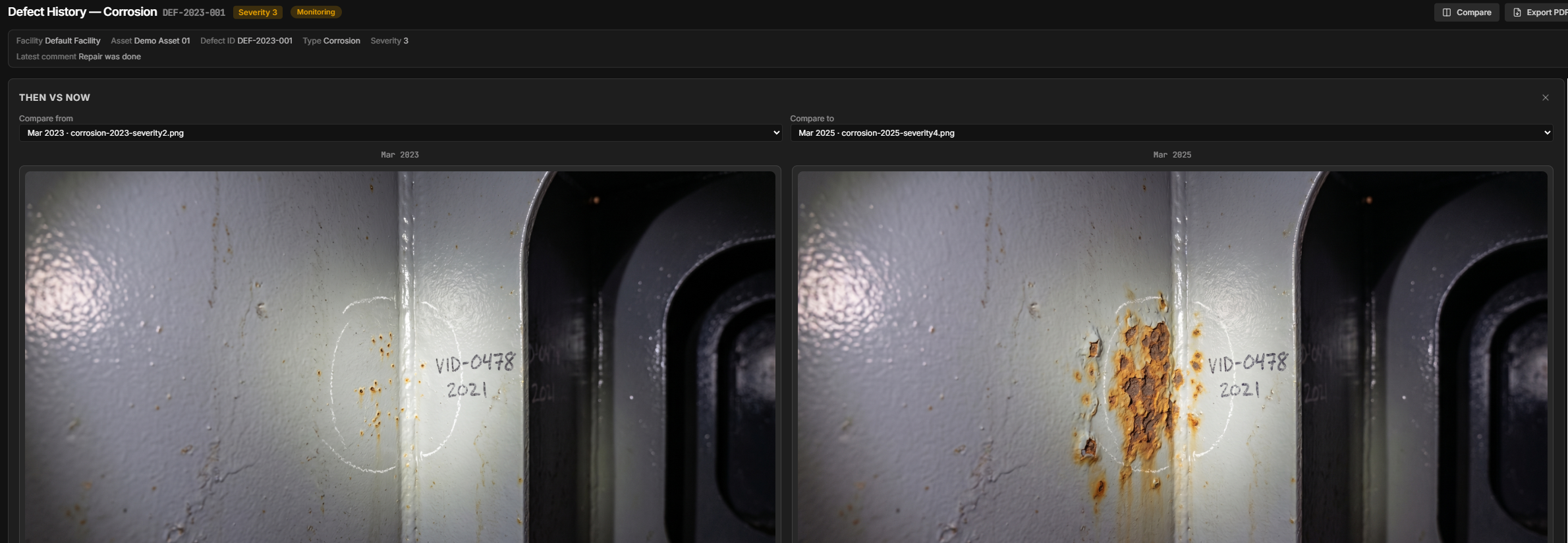
Instead of comparing PDFs side-by-side (which nobody actually does), you see a timeline:
Defect #A-2847 (Corrosion, Tank 3 - North Wall)
─────────────────────────────────────────────

2023-04-15: First identified, 12mm diameter, Severity 2
2023-10-22: Measured 18mm diameter, Severity 2
2024-04-18: Measured 31mm diameter, Severity 3 ⚠️
2024-04-20: Work order created (WO-4521)
2024-06-15: Repair completed, verified
2025-01-10: Re-inspection, repair holding
That's intelligence. That's what enables predictive maintenance.
Why This Matters for Compliance
If you operate in regulated industries—pharma, food & beverage, energy—you're facing increasing documentation requirements.
The EU's new guidelines (including the 2025 Annex 22 for AI in GMP environments) emphasize:
- Data traceability: Can you prove the chain of custody?
- Audit readiness: Can you produce historical evidence quickly?
- Decision documentation: Can you show why you took action (or didn't)?
A stack of PDFs doesn't satisfy these requirements. A Digital Thread does.
The "Then vs. Now" Question
Here's the test I use when evaluating inspection systems:
"If I find a defect today, can I instantly see what it looked like at every previous inspection?"
If the answer is no—if someone needs to dig through folders, cross-reference dates, and manually compare images—you don't have a Digital Thread. You have digital clutter.
Building Your Digital Thread
The transition from document-based to thread-based inspection doesn't happen overnight. But it doesn't require replacing all your equipment either.
Start with these principles:
- Assign persistent IDs: Every defect gets a unique identifier on first detection
- Capture location data: GPS where available, relative positioning where not
- Structure your metadata: Severity, type, measurements—in a database, not annotations
- Connect inspections: Same asset, same defect ID, updated data
The technology exists. The question is whether your organization is ready to treat inspection data as a strategic asset rather than a compliance checkbox.
What We've Learned at Viscendia
We've built the Viden platform specifically around the Digital Thread concept. Our focus areas—confined spaces, GPS-denied environments, complex industrial assets—demand this level of traceability.
But the principle applies universally. Whether you're inspecting pharmaceutical vessels, district heating networks, or construction projects, your future self will thank you for building connected data from day one.
The alternative is another PDF in another folder that nobody will ever open again.
Michael Elmegaard is the Founder and CEO of Viscendia, based in Aalborg, Denmark. He specializes in asset integrity and digital inspection solutions for complex industrial environments.
Want to see this in action?
Learn how Viscendia can help you apply proper inspection techniques to digital thread solutions.
Book a Demo