
The Same Conversation, a Different Industry — Why I Started Viscendia
A few years ago, I walked into a biotech facility for the first time.
Different industry. Different people. Different terminology. I came expecting to learn about problems I'd never encountered before. Instead, within the first conversation, I heard something I'd been hearing for years in wind:
"We spend too much time looking at data. Reports are scattered across inboxes. Nobody can find what they need when they actually need it. And every inspection means shutting things down for longer than anyone wants."
I'd heard that complaint before — just from people wearing different safety gear.
The Pattern Nobody Talks About
That moment stayed with me. Not because it was dramatic, but because it was so ordinary. The same frustrations, the same workarounds, the same resigned acceptance that this is just how inspection works.
I'm willing to bet the pattern extends far beyond wind and biotech. Anywhere people inspect physical assets — district heating, construction, pharmaceutical manufacturing, food production — the workflow underneath is remarkably similar:
Someone captures data — images, measurements, observations. An expert writes a report. The report gets emailed, filed, maybe printed. And within months, it's effectively lost. Not deleted — just buried. Sitting in a SharePoint folder or an inbox archive where nobody will ever look at it again.
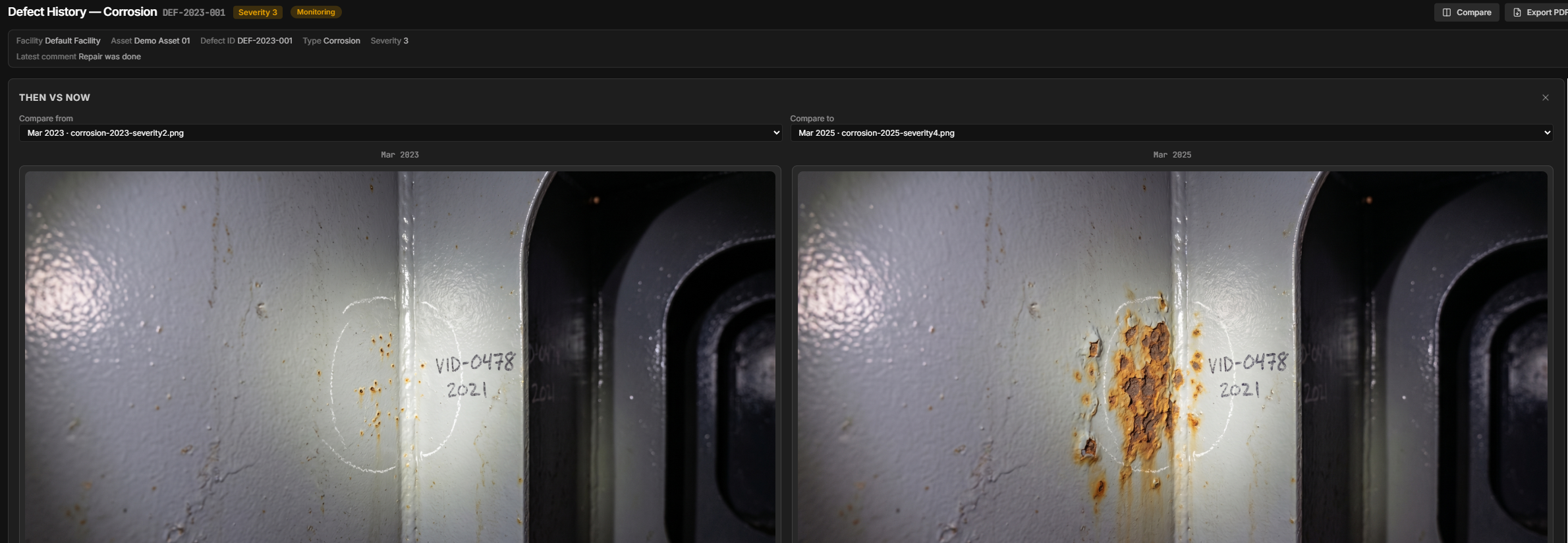
The real cost isn't the report itself. It's the question nobody can answer six months later: "Have we seen this before? Is it getting worse?"
That question matters. And in most organizations today, answering it requires someone to dig through folders, cross-reference dates, and manually compare documents. If it gets answered at all.
Two Problems, Two Solutions
When I started thinking about what Viscendia should be, I kept coming back to the fact that there are really two distinct problems hiding inside the word "inspection."
The first is the inspection itself. Getting access to the asset. Sending people into confined spaces, up towers, along pipelines. It's slow, expensive, and in some cases genuinely dangerous. Drones and robotics solve this — not because they're exciting technology, but because they remove unnecessary risk and downtime. You inspect more often, more safely, and without shutting down operations for days.
The second is what happens after. This is the part that most people underestimate. You now have data — images, measurements, observations. But data without structure is just noise. If every inspection starts from scratch, if there's no connection between what you found last year and what you're looking at today, then you're not building understanding. You're just accumulating files.
That's why we built Viden. It's a platform that makes inspection data coherent. Defects get a persistent identity — the first time you see corrosion on a tank wall, it gets an ID that follows it through every future inspection. The system connects observations automatically. Reports generate themselves. Instead of a stack of isolated documents, you get a timeline that actually tells you what's happening to your assets.
And sometimes, you need more than software. Sometimes you need someone to come in, capture the data, and help you make sense of it. We do that too — because the tool and the expertise shouldn't live in separate silos.
What We're Building at Viscendia
We're not the first company to talk about better inspection. But most solutions I've encountered solve one half of the problem — either the data capture or the data management — and leave you to bridge the gap yourself.
Viscendia exists because I believe those two halves belong together. Capture and intelligence. Hardware and software. The drone in the pipe and the platform that makes the findings useful six months from now.
We're hardware-agnostic. We don't sell drones — we help you use the right tool for the job, whatever that tool is. And we've built Viden so your data is yours. No lock-in, no proprietary formats, full export whenever you want.
I won't pretend we have all the answers. But after seeing the same problem across enough industries, I'm confident the current approach isn't good enough. Inspection data should be a strategic asset, not a compliance checkbox that gathers dust.
If any of this sounds familiar — the scattered reports, the time spent searching, the feeling that your inspection data should be doing more — I'd like to hear about it. Book a conversation and let's see if we're solving the same problem.
Michael Elmegaard is the Founder and CEO of Viscendia, based in Aalborg, Denmark. After years in offshore wind and industrial inspection, he started Viscendia to help asset owners turn inspection data into lasting intelligence.
Want to see this in action?
Learn how Viscendia can help you apply proper inspection techniques to digital thread solutions.
Book a Demo